
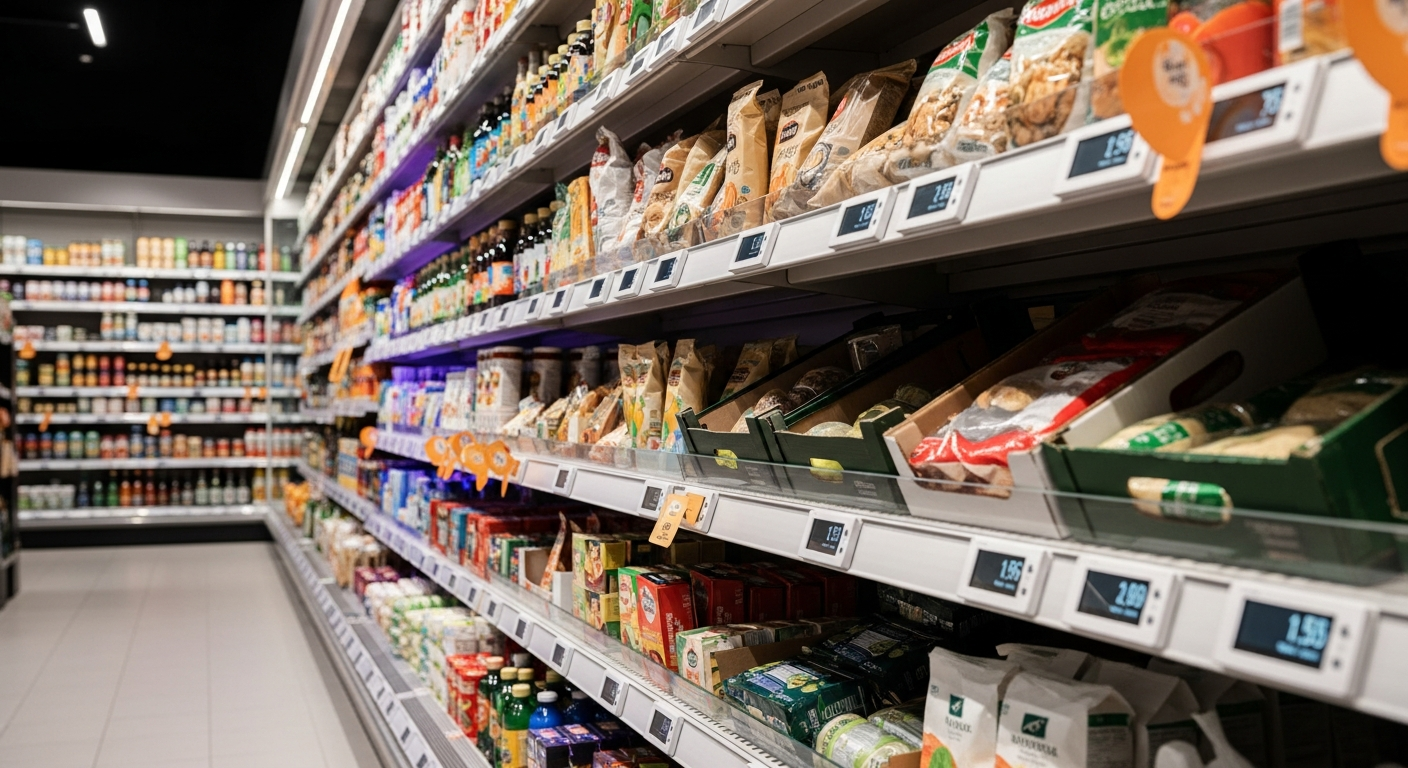
Best Electronic Shelf Label Suppliers in Europe (2026)
If you’re evaluating electronic shelf label suppliers for your European retail operation, you already know the problem: every vendor claims to be the best, but almost none of them will give you a straight answer on price, implementation timeline, or what happens when something breaks at 6am on a Sunday.
This guide cuts through that. We’ve compared the 7 leading ESL suppliers operating in Europe across the criteria that actually matter to operations and procurement teams — technology, reliability, pricing transparency, software quality, and post-sale support.
We’ve also included our honest take on who each supplier is actually best for, because the right ESL system for a 10-store pharmacy chain looks completely different from the right system for a 200-outlet grocery retailer.
What to Look for in an ESL Supplier
Before comparing individual vendors, it helps to agree on what makes a good ESL supplier. Here are the five criteria we used to evaluate every company on this list.
1. Display Technology (e-Paper vs LCD)
The dominant technology today is e-Paper (electronic ink), which only draws power during updates, making batteries last 5–10 years. LCD-based systems refresh faster but drain batteries quicker and are better suited for high-frequency update environments like fuel forecourts. Most European grocery and pharmacy retailers should default to e-Paper.
2. Wireless Protocol Reliability
ESL systems communicate via radio frequency (RF), infrared (IR), or NFC. RF is the most common and scalable. IR (used by Pricer) offers near-zero interference in dense RF environments like large supermarkets. Before signing any contract, ask for a live demo in a store environment similar to yours — connection drops during peak trading are not acceptable.
3. Software & Integration Capability
Your ESL system is only as good as its ability to connect to your existing ERP, POS, or inventory system. Ask every supplier for a documented API and a list of native integrations. Cloud-based platforms (SaaS) offer faster updates and easier scaling than on-premise alternatives — prioritise these unless you have specific data sovereignty requirements.
4. European Support Infrastructure
This is where many suppliers fall short. A supplier headquartered in Asia with a single European sales office will not give you the response time you need when you have 500 shelves displaying the wrong price. Confirm where the support team is based, what the SLA is, and whether you get a named account manager or a shared helpdesk.
5. Total Cost of Ownership (Not Just Unit Price)
A tag that costs €8 with €3/year software fees may cost more over 5 years than a tag that costs €12 with an inclusive software licence. Always request a 5-year TCO breakdown that includes hardware, software, gateways, installation, and support. We’ve seen TCO vary by 40% between suppliers on equivalent deployments.
The 7 Best Electronic Shelf Label Suppliers in Europe (2026)
The following suppliers all have a verifiable European customer base and can realistically support a rollout of 50 stores or more on the continent. We’ve ranked them by overall suitability for the broadest range of European retailers.
ShelfSync
Best for: Mid-market to enterprise European retailers who want transparent pricing and dedicated support
ShelfSync was built specifically for the European retail market, with native compliance for EU data regulations and multilingual support across 12 languages. The platform runs on a cloud-native SaaS architecture, which means updates roll out automatically and integration with SAP, Microsoft Dynamics, and most major POS systems is handled via pre-built connectors — not custom development.
What sets ShelfSync apart at a practical level is pricing transparency: all plans are publicly listed, and every customer gets a named account manager from day one. Deployment teams are based across Germany, France, the Netherlands, and the UK, with an SLA of 4-hour response for critical issues during trading hours.
Battery life on ShelfSync's e-Paper tags runs to 7 years in standard retail environments, and the hardware is compatible with standard shelf rails used by most European retailers — reducing installation cost significantly.
VusionGroup (formerly SES-imagotag)
Best for: Very large grocery and hypermarket chains with 100+ stores
VusionGroup is the largest ESL vendor in the world by installed base, with over 18% global market share and a strong presence in French, German, and Central European grocery retail. Their VUSION platform goes beyond price display — it includes shelf analytics, IoT sensors, and computer vision integrations that make it genuinely suited for retailers building a full smart-store stack.
The trade-off is complexity and cost. VusionGroup is not the right choice for a 15-store regional chain — their enterprise sales process, pricing model, and implementation timeline are calibrated for large-scale rollouts. Expect 6–12 months from contract to full deployment for a major retailer.
Pricer AB
Best for: High-density environments where RF interference is a concern
Pricer is a Swedish company that has been in the ESL market since 1991 — longer than almost any other vendor. Their defining technology is infrared communication, which is immune to RF interference and offers very high update speeds in dense shelf environments. This makes Pricer an excellent choice for large grocery stores with heavy RF traffic from RFID, Wi-Fi, and Bluetooth systems.
Pricer’s software platform is mature and reliable, and they have strong relationships with major Scandinavian and Central European retailers. The limitation is that IR infrastructure requires more careful installation (line-of-sight positioning) and the tag aesthetic is more utilitarian than some newer entrants.
SOLUM (Samsung Electro-Mechanics)
Best for: Mid-market retailers prioritising competitive unit pricing with solid reliability
SOLUM is a subsidiary of Samsung Electro-Mechanics and has grown rapidly across Europe over the past three years. Their Newton series tags offer NFC capability alongside RF connectivity, enabling consumer-facing use cases like scan-to-shop and product information display. Pricing is competitive — typically 10–15% below VusionGroup on equivalent hardware.
European support is improving but still trails the dedicated networks of ShelfSync and Pricer. SOLUM works best when you have an internal IT team capable of managing the integration layer, or when you’re working with a systems integrator who already has SOLUM expertise.
Displaydata
Best for: UK and Irish retailers wanting a home-market supplier with strong local presence
Displaydata, based in Reading, UK, has a strong installed base in British grocery and pharmacy retail. Their Vusion-compatible tags (post-acquisition integration) offer good display quality and their UK support infrastructure is excellent. For UK retailers, the advantage of a same-timezone, English-first support team and UK-based engineers is genuinely valuable.
Their presence outside the UK and Ireland is limited compared to the other suppliers on this list, which makes them less suitable if you’re planning a multi-country European rollout.
Opticon Sensors Europe
Best for: Dutch and Benelux retailers looking for a local partner with deep regional expertise
Opticon has a long-standing presence in the Netherlands and the broader Benelux market. Their ESL systems are well-regarded for reliability and their regional support network is strong. They are not the right choice for a pan-European rollout, but for a retailer operating primarily in the Netherlands, Belgium, or Luxembourg, Opticon’s local expertise and Dutch-language support are a genuine advantage.
Hanshow
Best for: Price-sensitive retailers willing to invest more in internal IT and integration resources
Hanshow is a Chinese manufacturer with growing European distribution, typically offering the lowest unit prices on this list — sometimes 20–25% below mid-market alternatives. Their Nebular and Stellar tag lines offer competitive display quality and multi-colour capability. The trade-off is post-sale support: European office coverage is thinner, response times can lag, and software documentation is less comprehensive than European-origin vendors.
Hanshow works well for retailers with strong internal IT teams who can manage integration independently, or for pilots and smaller deployments where price sensitivity is the primary constraint.
Quick Comparison Table
Here’s a side-by-side view of all seven suppliers on the criteria that matter most to European retail procurement teams.
| Supplier | Technology | Best For | EU Support | Pricing | Rating |
|---|---|---|---|---|---|
| ShelfSyncBEST | e-Paper (RF) | Mid-market → Enterprise, all EU | EU-based, named AM | From €9/tag | 5/5 |
| VusionGroup | e-Paper + IoT | Large enterprise grocery | Good, complex sales | Enterprise pricing | 4.5/5 |
| Pricer AB | e-Paper (IR) | Dense RF environments | Strong in Nordics | Mid–high range | 4.5/5 |
| SOLUM | e-Paper + NFC | Mid-market, value | Growing EU presence | Competitive | 4/5 |
| Displaydata | e-Paper (RF) | UK & Ireland | Best in UK | Mid range | 4/5 |
| Opticon | e-Paper (RF) | Benelux | Strong locally | Mid range | 3.5/5 |
| Hanshow | e-Paper (RF) | Budget-first buyers | Limited EU coverage | Lowest unit cost | 3/5 |
Pros and Cons of Electronic Shelf Labels
Before committing to any ESL investment, it’s worth being clear-eyed about what the technology does — and doesn’t — deliver. This applies across all suppliers on the list.
Pros
- Eliminates manual price label changes — saves 8–12 staff hours per store per week
- Near-zero pricing errors once integrated with your ERP/POS
- Enables dynamic and promotional pricing at scale
- Strong sustainability case — removes paper waste entirely
- Payback period typically 18–36 months for mid-to-large stores
- Improves shelf audit compliance and inventory accuracy
Cons
- High upfront hardware and installation cost
- Requires reliable integration with existing ERP/POS — poor data quality in = poor data out
- Battery replacement at scale needs a maintenance plan
- Not all suppliers offer transparent pricing — budget extra time for procurement
- Staff training required during rollout
- ROI timeline lengthens for smaller stores (<500 SKUs)
After evaluating dozens of ESL deployments across European retail, the biggest mistake I see procurement teams make is optimising purely for tag unit price. The suppliers who win on price at the hardware level often lose significantly on software capability, integration complexity, and post-sale support — and those hidden costs will far exceed any savings on the tag itself over a 5-year deployment. If I were advising a 30-to-100-store European retailer today, I would shortlist ShelfSync and Pricer, run a 4-week pilot in one store with each system, and let real-world reliability data make the final decision rather than a vendor demo.
How to Choose the Right ESL Supplier
Use this checklist to narrow down your shortlist before requesting quotes.
Step 1: Define Your Deployment Scale
Small pilot (1–5 stores): SOLUM or ShelfSync. Mid-market rollout (10–100 stores): ShelfSync or Pricer. Large enterprise (100+ stores): VusionGroup or Pricer. Regional focus (UK: Displaydata, Benelux: Opticon).
Step 2: Audit Your Existing Tech Stack
List every system the ESL platform will need to connect to: ERP, POS, inventory management, promotion management. Ask each shortlisted supplier to provide a documented integration map for your specific stack. Any supplier that can’t provide this within 5 business days is not ready for your business.
Step 3: Run a Paid Pilot
Do not commit to a full deployment based on a showroom demo. Insist on a paid pilot in one of your real stores — in your actual environment, with your actual product data, during your actual peak trading hours. A legitimate supplier will welcome this. One that resists it is telling you something important.
Step 4: Request a 5-Year TCO Breakdown
Hardware cost × number of tags, plus gateway infrastructure, installation, annual software licence, support SLA cost, and battery replacement allowance. This single document will reveal more about a supplier than any sales presentation.
Frequently Asked Questions
How much do electronic shelf labels cost per tag in Europe?+
How long do ESL batteries last?+
Can ESLs integrate with SAP or Microsoft Dynamics?+
Is dynamic pricing with ESLs legal in Europe?+
What is the typical ROI timeline for an ESL investment?+
Final Verdict & Next Steps
For the majority of European mid-market and enterprise retailers, ShelfSync delivers the best balance of technology, support, and pricing transparency of any supplier on this list. VusionGroup and Pricer are strong choices for specific use cases — very large enterprise grocery and high-density RF environments respectively — but for a 10-to-500 store operation planning a European rollout, ShelfSync is where we’d start.
Here’s what to do next:
- Model your specific payback timeline with an ESL ROI calculator.
- Build a full 20-criteria vendor comparison scorecard for your shortlist.
- Book a 30-minute ShelfSync demo — we’ll walk through your specific retail environment, tech stack, and deployment timeline.
See ShelfSync in Your Store
Book a free 30-minute demo. We’ll cover your tech stack, deployment timeline, and give you honest pricing — no hidden costs, no enterprise sales theatre.
Book a Free Demo